Want better health? Eat better food. Nutrition First.
The Truth about the Sugar Diet: 7 Red Flags You Need To Know
🍬 Marshmallows. Hard candy. Gummy worms.
Not your Easter basket or Halloween haul…your new health plan. At least, if you’re following the Sugar Diet.
It sounds like a joke.
I wish it were a joke.
A growing number of people are skipping dietary fat, chugging maple syrup, and swearing they’ve never looked leaner.
And I believe them. I really do.
In my youth, I ate sugar all day long, and I got away with it.
For a while.
But eventually, my body sent the bill:
➡️ Symptoms of early Alzheimer’s disease.
➡️ Chronic inflammation.
➡️ Weight gain anyway.
Are you tempted to jump on the sugar train?
I get it, I do. What’s more, I don’t think I could have talked my younger self off of the sugar ledge. But if you are at all wavering, let me walk you through why this candy crush romp might just be the worst health trend of the decade.

What is the Sugar Diet?
There are three components to the Sugar Diet.
Eat pure sugar during the day.
Avoid fat day and night.
Eat low-fat protein for dinner.
Nuts? I agree. But Cole Robinson of Snake Diet fame and fitness expert Mark Bell insist that it works for rapid fat loss.
What does this look like?
Pure sugar. Note that although I often preach that all carbohydrates are sugar in the eyes of your belly, this perspective does not hold here. For the Sugar Diet, complex carbohydrates are not sugar. The Sugar Diet stipulates foods made only with simple sugars and without starch, protein, or fat.
Therefore,
🧃 YES to honey, maple syrup, strained fruit juice
🍫 NO to chocolate (made with fat), ice cream (ditto), cookies and crackers and cakes (fat and starch)
Fat is, as usual, the bad guy. Bell recommends keeping daily fat intake under 30g, a limit shared by others following this protocol.
Low-fat protein is eaten only at dinner, in what Bell describes as a ‘moderate’ amount. He shares that he eats ‘half his body weight’ in grams. That could mean 100g in one sitting for him, 60–70g for someone like me.
I aim for 30g per meal, and I feel that’s a lot! Double plus that? Hardly “moderate.”
Why does this method work?
Proponents like Mark Bell argue that sugar eaten without fat or starch does not get stored as body fat. Instead, pure sugar actually trains the metabolism to burn hotter. In his words:
‘Feed the body sugar, you’re going to burn more. Feed it more sugar, you’re going to burn more and more and more.’ ~ Mark Bell
So the Sugar Diet actually works?
Short-term? Maybe.
Long-term? That depends on how you feel about brain shrinkage, hormone collapse, and insulin resistance.
Look, it may very well deliver weight loss. But I see red flags. Let’s talk about seven of them.
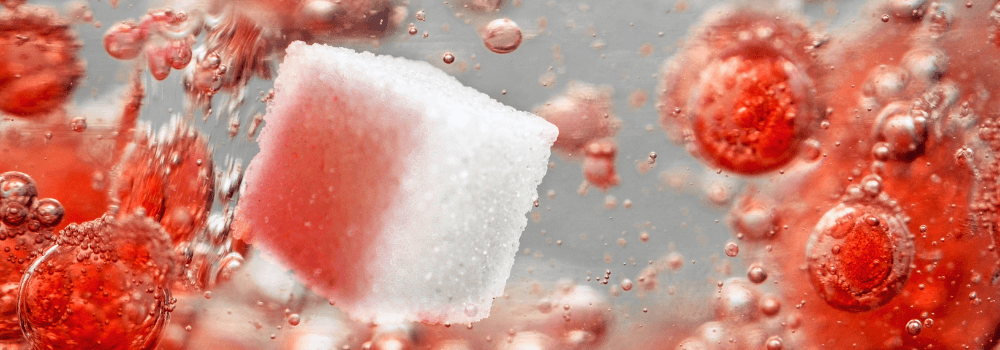
1. 🚩Emergency!
Sugar Flood in the Blood. ⚠️
Sugar offers energy…and nothing else.
Not a single vitamin, mineral, or essential fat. Your brain is begging for B vitamins, choline, and magnesium. Good luck rebuilding hormones, bones, or neurotransmitters on glucose alone. Sugar has nothing for you.
You already have energy, by the way. Yup, stored in your fat cells. Won’t get touched when you are eating sugar, of course. But it is there. Waiting.
According to Healthline, “Sugar contains energy but no nutrients. It is the definition of an empty calorie.”
Empty…but not harmless.
Sugar is not “neutral.”
Sugar is a metabolic red alert, one we don’t need. Not even a little.
Our bodies circulate about 5 grams of glucose in the bloodstream at any given time. When we choose to eat carbs, we spike that number. Sometimes a little, maybe +8 net grams of carbs for a slice of onion. Sometimes a lot: 24g for a handful of marshmallows, 34g for a bottle of apple juice.
Eating sugar throughout the day puts the body into metabolic emergency mode. The body goes on high alert, rushing to burn off and/or store the excess sugar. What spikes up must crash down, and that crash brings cravings, irritability, fatigue.
It’s a punishing cycle, not steady fuel.

2. 🚩Rapid Aging: A Sugar Perk.👵
The Glucose Goddess, Jessie Inchauspé, offers all sorts of hacks for enjoying sugar without spiking blood sugar. Eat a savory breakfast. Drink apple cider vinegar. Fiber before sugar.
Why is she so concerned with limiting blood sugar spikes? Here is one reason:
With AGE comes faster aging.
One of the ways our bodies respond to excess sugar is a process called glycation. Glycation causes sugar molecules to bind to proteins. Unfortunately, this damages our tissues and creates AGEs: Advanced Glycation End-products.
AGEs accelerate aging, damage skin and organs, and play a role in degenerative disease.
The Glucose Goddess warns us to keep our blood sugar steady if we are at all interested in slowing aging.
I, myself, would like to slow aging. Heck, I’d like to reverse it!
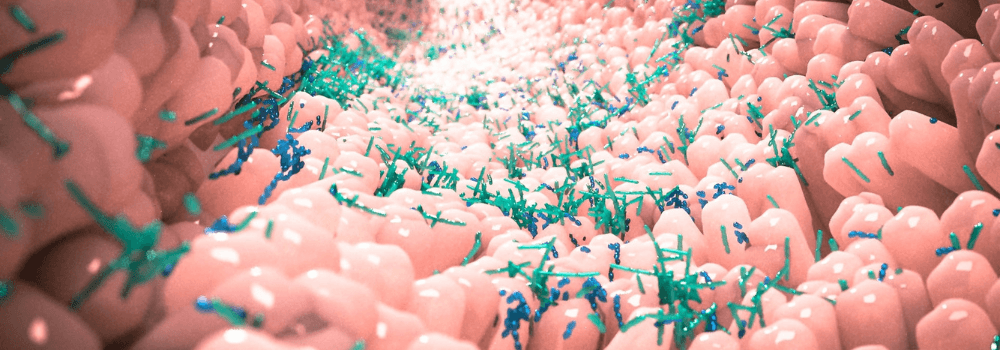
3. 🚩Gut Check: Your Starving Microbiome🦠
Scientists now call the gut your “second brain.”
Your gut does far more than digest food. It regulates inflammation, trains your immune system, and produces most of your body’s serotonin — that key chemical that helps you feel calm, balanced, and okay in the world.
All that magic? It’s thanks to the trillions of microbes living inside you. Some are beneficial. Some are…very much not.
And when you sip sugar all day?
You’re not feeding the good guys. You’re breeding the bad guys — the ones that thrive on sugar and offer nothing in return.
They do not boost your mood. They do not protect your brain. They do not support your immune system.
They just demand more sugar.
That’s not fuel. That’s sabotage.
And when those sugar-loving squatters take over, you get cranky.
Feels so good? Not so much.
Fat builds steroid hormones like estrogen and testosterone. The feel-good hormone serotonin? That’s mostly made in your gut — with help from a healthy microbiome.
Disrupt your microbiome, and you’re not just messing with digestion: you’re kissing calm “Adios!” and saying “Welcome!” to mood swings.
But wait, there’s more!
4. 🚩Sick. Sugar Fuels Disease. 🚑
A spoonful of sugar… spikes your blood glucose.
And continual blood sugar spikes throughout the day = continual insulin spikes.
WAIT!
If you’re anything like me, you are already tuning out because insulin is a diabetes thing, and you are not diabetic.
Now hear this: we all have insulin. We all need it. But frequent insulin spikes? They cause problems. Big problems.
Insulin spikes trigger chronic inflammation.
And chronic inflammation is the root of nearly every chronic disease, conditions such as
➡️Heart disease,
➡️ Diabetes, Type 2,
➡️ Autoimmune disorders,
➡️ Mental health issues,
➡️ Alzheimer’s.
Yes, sugar has been linked to a higher risk of Alzheimer’s — but more on that in a minute.
Even many cancers are now recognized as a metabolic disease.
And guess what cancer cells love? Sugar.
Ketones, your body’s alternative fuel source? Cancer can’t use them. Sugar? Tumors gobble it up.
I understand that you may feel fine now, but…
…chronic inflammation flies under the radar.
It can take years — even decades — for the damage to surface.
And by the time it does? The damage is already done.
Still pinning your hopes on a magic pill later? Didn’t work out for me. Luckily, I found something better (hint: real food).
Can’t resist chasing a slim summer body with the Sugar Diet?
Enjoy it while you can.
You may be losing weight —
…but you’re probably losing health too.

5. 🚩Sugar Steals Your Mind 🧠
Sugar is sweet, but there is something more. Let’s talk about...
Sugar Cravings
Cocaine lights up your brain’s reward center.
Sugar lights it up more.
One study found rats preferred sugar water over cocaine.
Cravings? Not weakness, but chemically engineered addiction.
But sugar doesn’t just hit your hips, it hijacks your hippocampus.
Sugar Brain
Your hippocampus is your memory center. And it’s shrinking.
The weight may fall off. Along with clarity and recall. Welcome to confusion.
Because sugar isn’t just linked to Alzheimer’s. One study warns that sugar may drive dementia. Not merely contribute to it. Drive it.
And here’s the scariest part: Brain damage takes time to show up.
You might feel fine today. But by the time you notice slipping? Much harder to reverse.

6. 🚩Shun Fat & Cripple Your Hormones😌
Here once again we find a ruthless, unfettered, unfounded attack on fat.
Fat is not the enemy.
Fat is essential. Of the three macronutrients, two are essential: protein and fat.
Fat triggers leptin, which helps you feel full. It builds your cell walls. It’s how you absorb vitamins A, D, E, and K. And, critically, it’s how you make hormones.
Who needs hormones? You do!
We need fat to build and balance our hormones — especially steroid hormones like estrogen, progesterone, and testosterone, which are made from cholesterol. Shun fat and risk fertility problems and PCOS.
No fat? No hormones. No hormones? No health.
Low fat means no building blocks. High sugar means no balance. That’s a recipe for mood swings, anxiety, and the kind of tearful breakdowns we like to blame on stress. Sure, you might be stressed. But your roller coaster moods are likely caused by foods.
You might get shredded. But your ovaries won’t thank you.
Low fat? A big fat problem. (Sorry, I could not resist.)

7. 🚩Protein Problems?🥩
Protein isn’t the problem. In fact, it’s a plus.
But the Sugar Diet’s approach to protein? My Spidey senses are tingling.
Let’s start with the good: protein is essential.
It rebuilds tissue, supports muscle, and powers countless hormone and enzyme functions. Bonus: protein takes more energy to digest than carbs or fat, so it gives your metabolism a little boost just by showing up to dinner.
Does the Sugar Diet get credit for including protein in one meal? Meh.
Unfortunately, most women aren’t eating enough protein.
You want to look lean? You might end up looking…flat. Because unless you’re a powerlifter or an elite eater, it’s tough to get a full day’s worth of protein in one sitting. And without enough protein, you risk reducing lean muscle.
That said, if you embrace one meal a day and still hit your protein target…excellent. Rock star.
But if you’re a mere mortal like me, sipping sugar all day and skimping on protein later could lead to the wrong kind of weight loss. Muscle loss.
The Sugar Diet calls for eating lean, low-fat protein only.
Egg whites. Skinless chicken breast. Maybe shrimp. In theory, fine. But in practice, we’re talking about protein stripped of everything that makes it truly useful. Yes, I am talking (again) about fat.
No fat means no access to fat-soluble vitamins.
No fat means no hormonal support.
No fat means you’re hungry again in an hour.
Wait — hungry again? Really? Protein does help us feel full — no question. It raises satiety hormones, takes effort to digest, and dials down hunger. But protein without fat is like caffeine without sleep. You’re faking fullness — it won’t last.
Here’s where it gets slippery.
The Sugar Diet is decidedly not plant-based —
Mark Bell and Cole Robinson both emphasize lean animal proteins…
…but I can already see how some might adopt a plant-based variation.
Especially young people. Especially women. Especially the tender hearts already skittish about eating meat.
The problem?
Plant-based proteins aren’t just low-fat. Compared to animal-based protein, they are decidedly low-nutrient. Moreover, they come bundled with compounds that block nutrient absorption. Yes, I’m talking about antinutrients like lectins and oxalates.
Eat the protein, but don’t absorb nutrition? Not much of a win.
I am pro-nutrient. Plants? Not so much.
And unlike a steak or ground beef, which provides complete nutrition in the exact ratios we need, most diets that rely on plant proteins require careful mixing, processing, and supplementing to approach ideal nutrition levels.
Dr. Georgia Ede calls ruminant meat “the original superfood.”
It would be tragically easy for someone chasing fat loss to take this questionable Sugar Diet and make it even worse by swapping lean meat for highly processed, low-fat, nutrition-deficient plant-based powders.
Here’s the Skinny
Could you lose weight on the Sugar Diet? I’ll give you that. But should you? Chances are your slim self will also be
Anxious and moody
Undernourished
Brewing chronic disease
There is good news and bad news here. The bad news is that if you are eating either the Sugar Diet or the Standard American Diet, you are laying the foundation for chronic illness for years, decades, before symptoms emerge.
But the good news? Concerns like fatigue or mood swings can improve in mere days just by improving your diet.

But — but — but — It’s just a short-term diet!
Oh? You are only doing this for a couple of weeks?
Great. Good to know.
I do have two questions.
First, if my only goal is losing weight and this is doing it for me, why would I stop? I probably wouldn’t, especially not if I had a lot of weight to lose, or if I were young, or if I were getting a lot of positive feedback on my results. I probably would keep on sugaring.
And I’d probably suffer health hits.
Calling this just a short-term solution for weight loss is like saying smoking is just a short-term solution for stress.
Second, if and when I do stop, what then? Will the weight return?
I am thinking…probably.
And if you are thinking: Same same with a clean low-carb diet! Processed carbs on the plate; start to gain weight.
Fair. But here is the difference, and it matters. A lot.
A clean, low-carb diet is nutrition first, supporting both brain and body health.
A clean, low-carb diet is good food for good health. For life.

What do you want?
Am I saying you’re foolish for trying this? No. You’re not wrong to want results. But I want results and health. Can this diet give you both?
Could you lose weight on the Sugar Diet?
The Sugar Diet may work. So do tapeworms.
Weight loss is not health.
Do I contradict myself? Yup.
I have often held that healthy weight is a marker for a healthy metabolism. However, I am 100% willing to make an exception for drug addiction.
Heroin chic is not a desirable goal.
Neither is sugar chic.
The Sugar Diet is proof that we’ve hit peak nutritional confusion.
Seeking More?
Health & happiness in addition to scale goals?
The older (so much older) and wiser me chooses clarity over chaos. For me, that means nutrition first, choosing clean low-carb food that fuels my brain and body. Plus a few other habits that support, not sabotage, my future.
Let’s all stay strong, wise, kind, and good.
Choose good food for good health.

Want help getting started?
A clean low-carb diet reversed the worst of my early Alzheimer’s symptoms.
Want to learn more?
✨🧠✨ Grab my free guide, 7-Days to a Clearer Mind:
https://www.strongwisegood.com/7-days-clearer-opt-in
I’m not a doctor, scientist, or nutritionist. I’m just a late boomer sharing what I’m learning on my journey to good health through good food.
Until next time, stay strong, wise, kind, and good.
Choose good food for good health.
🔬 Research & Resources
Find all the key studies and public resources referenced here: 👉 Full Source List – Click Here
Disclaimer: I am not a doctor, not a scientist, not a nutritionist. I am not qualified to give medical advice. I am just a late boomer sharing what I’m learning on my journey to good health through good food.

Good morning!
I am a late boomer spreading the gospel of good health through good food.
My bona fides?
Beating back Alzheimer's by eating clean low-carb.
And dropping a little weight effortlessly as a bonus.
Real food for real health.
Join me?
NOTE:
All communications, including order confirmations and support, will come from our sister brand, Prosperity Porch, part of Jomac Girls LLC. Trust emails from thegals@prosperityporch.com.